



Media Reach: Genomic Press
With over 4,000 news stories and counting, we cannot possibly list them all. Below you will find a selection of coverage highlights.
AP News Wire and MSN.com Highlight a Breakthrough Published in Genomic Psychiatry: OTULIN Controls Tau Expression
Since its 25 November 2025 publication, this Genomic Psychiatry study has captured worldwide media attention: over 275 news outlets in English, Spanish, Portuguese, Italian, and Japanese, including prominent placement on MSN.com and distribution through the Associated Press news wire, whose journalism reaches an estimated 4 billion people daily worldwide.
With ~1.3 billion monthly visits, MSN.com ranks among the world's top news portals. This latest feature continues a remarkable trajectory: more than 20 Genomic Press papers have now appeared on MSN.com, bringing cutting-edge biomedical research to global audiences.
The Discovery
"We originally hypothesized that inhibiting the deubiquitinase OTULIN would promote clearance of toxic tau aggregates by stabilizing linear (M1-linked) ubiquitin chains," said first author Dr. Karthikeyan Tangavelou. "Instead, the results completely overturned our expectations."
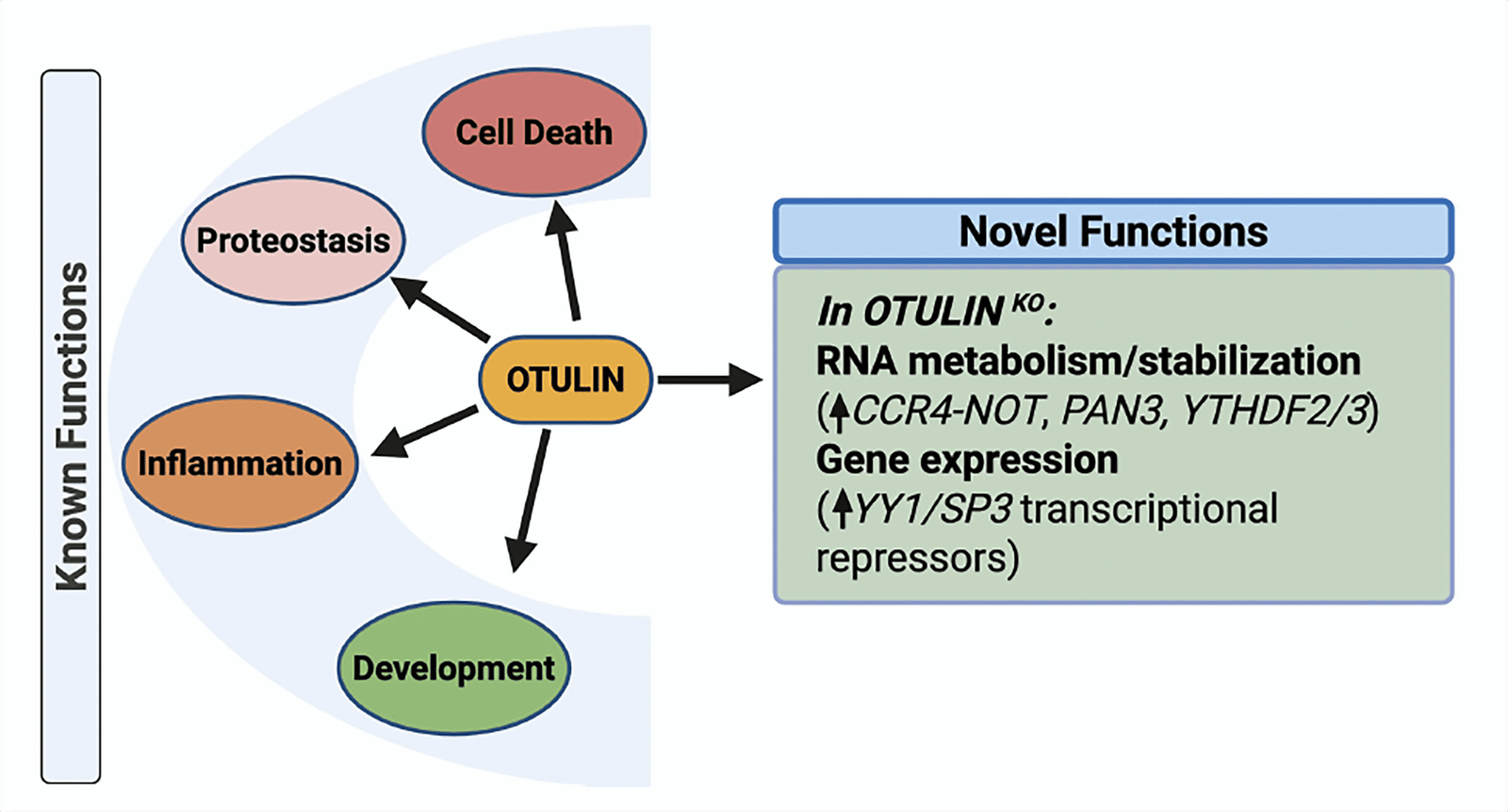
Working with patient-derived neurons (iPSNs) carrying sporadic Alzheimer's pathology and human SH-SY5Y neuroblastoma cells, the team led by Dr. Kiran Bhaskar (University of New Mexico) and Dr. Francesca-Fang Liao (University of Tennessee) discovered that OTULIN, previously known only for controlling inflammation, plays a previously unrecognized central role in neuronal RNA metabolism and directly regulates expression of the tau protein (encoded by the MAPT gene).
Key findings:
- Patient-derived Alzheimer's neurons showed elevated OTULIN protein and increased pathogenic phospho-tau (AT8+, AT180+, PHF-1+).
- A novel small-molecule inhibitor of OTULIN (UC495) significantly reduced pathogenic phospho-tau species in these human neurons.
- Complete genetic knockout of OTULIN eliminated tau expression entirely, not only the protein, but also MAPT mRNA, while leaving neuronal survival and differentiation intact.
- RNA-sequencing revealed massive transcriptome remodeling (>13,000 genes and >44,000 RNA transcripts differentially expressed), confirming OTULIN as a master regulator of RNA processing, stability, and gene expression in neurons.
These results, published in Genomic Psychiatry (2025), reveal an unexpected non-canonical function of OTULIN and identify it as a promising new therapeutic target for Alzheimer's disease and other tauopathies.
Discover Magazine Features Brain Medicine Research: Exercise Counters Junk Food's Effects on the Brain
This Brain Medicine study has been covered by 50+ news media stories worldwide in multiple languages, including Discover Magazine, Science Daily, News-Medical, Infobae, Correio Braziliense, MeteoWeb, Ireland Press Journal, Polish Press Agency, 163.com, Bionity, IANS Live, Ma Clinique, Nefes Gazetesi, and Metronieuws.
Key Discovery
While it is established that a high-fat/high-sugar "cafeteria" diet induces depressive-like and anxiety-like behavior in rats, this study shows for the first time that voluntary wheel running completely reverses these effects, primarily through restoration of gut-derived metabolites (indole-3-carboxylate, GLP-1), normalisation of insulin and leptin, and rescue of hippocampal neurogenesis.
"Exercise has an antidepressant-like effect in the wrong dietary context, which is good news for those who have trouble changing their diet," stated Professor Julio Licinio in the accompanying editorial.
The research team, led by Professor Yvonne Nolan at University College Cork, employed untargeted metabolomics to reveal that the cafeteria diet dramatically altered the gut metabolome, affecting 100 out of 175 measured metabolites. Exercise showed more selective effects, partially restoring three metabolites linked to mood regulation: anserine, indole-3-carboxylate, and deoxyinosine.
Perhaps most intriguingly, the study found that the cafeteria diet prevented the typical exercise-induced increase in adult hippocampal neurogenesis, suggesting that diet quality may fundamentally alter the brain's capacity to benefit from physical activity at the cellular level.

Exercise as Metabolic Medicine: Movement Counters Diet-Induced Behavioral Despair via Gut-Brain Signaling
The editorial places these findings in today's context: ultra-processed diets are driving a global surge in depression. Exercise functions as genuine, non-pharmacological "metabolic medicine" capable of overriding the mood-damaging effects of poor diet through the gut-brain axis.
Read the Editorial →